The Flying Perugian and His Ingenious Family
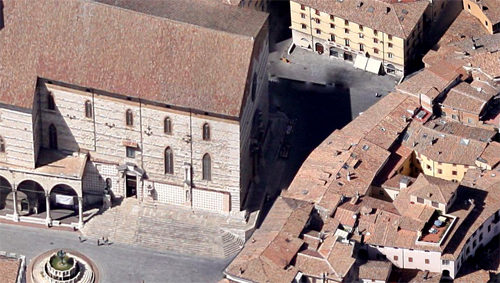
Piazza Danti, in Perugia
PERUGIA – Giovan Battista Danti was a child prodigy. Born in Perugia in 1478, he excelled as both a mathematician and physicist. Before reaching his twenties, he had already achieved renown at the university. The Baglioni, the feared lords of the city, kept a watchful eye on him, particularly interested in his military engineering projects.
Yet the young scientist's mind was consumed by a secret ambition: to realize the prophecy of the medieval philosopher Roger Bacon, who in the thirteenth century wrote: "We will succeed in constructing winged machines capable of rising into the air like birds." Unlike the "doctor mirabilis," however, Giovan Battista dreamed of flight without mechanical assistance.
His fellow citizens, with a touch of mockery, called him Daedalus—after the unlucky yet brilliant character from Greek mythology who watched his son Icarus plunge into the sea after flying too close to the sun while escaping the labyrinth of the fearsome Minotaur, a maze Daedalus himself had designed.
Like his mythical namesake, Giovan Battista conceived of two large wings to achieve his dream. But he didn't make them from wax. He wanted them enormous, crafted from leather and the lightest woods possible. Most importantly, he ensured they were proportioned to his weight. For this, he studied various solutions, carefully examining the curvature of birds' wings and how winds would impact his innovative structure.
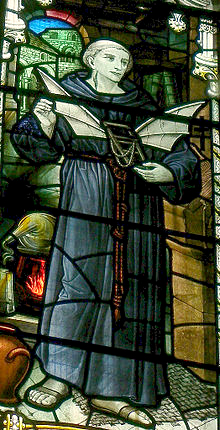
The Benedictine monk Eilmer of Malmesbury was one of the pioneers of human flight
THE WINGED MEN
Certainly, despite his profound learning on the subject, Giovan Battista could not have known about the ancient Chinese traditions of kites and sky lanterns, which for centuries had risen into the heavens like modern hot air balloons, lifted by air heated by small candles. Perhaps he had read the legendary story of Archytas, a Greek astronomer who nearly 400 years before Christ had built a mechanical dove from wood that rose into the air thanks to steam. And he had surely heard of a certain Armen Firman who in the year 852 in the Iberian Peninsula constructed a great cloak resembling an umbrella with stiffened fabrics. Dressed in this garment, he leaped from the minaret of the Cordoba mosque without suffering serious injury, pleased to have created a device similar to the modern parachute.
Another extremely courageous experimenter, shortly after the year 1000, was a Benedictine monk, Eilmer of Malmesbury, a student of astrology who in his youth broke both legs after launching himself from the abbey tower with a kind of glider. He remained lame for the rest of his life, yet remained convinced that if he had attached a mechanical tail to his body, he could have achieved a soft landing. His superior, the abbot of Malmesbury, wisely forbade him from any further experiments. Thus, with many regrets, Eilmer spent the remainder of his days in prayer and working on his astrological treatises.
The bold exploits of these winged men were studied by the Perugian mathematician. But Giovan Battista wanted to go beyond improvisation. It wasn't merely a question of courage. The challenge of flight had to be approached scientifically. Just as Leonardo da Vinci was doing in those same years—twenty-six springs older than him—who had long been collecting meticulous technical observations on aerodynamic resistance. Extraordinary studies that would later flow into his famous "Codex on the Flight of Birds," one of his many unfinished yet marvelous works. Leonardo dreamed of splendid machines that "beat their wings" like that amazing "Great Kite," which he built by closely observing the circling of the raptor.
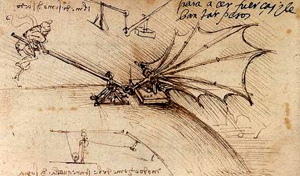
One of Leonardo da Vinci's designs for flapping-wing flight
THE MEETING WITH LEONARDO
Danti sought other paths. He maintained that man could indeed fly but with still wings, exploiting favorable winds and updrafts, much like today's gliders or hang gliders. Sparse chronicles of the time recount that the two scientists once met thanks to Giampaolo Baglioni, the powerful lord of Perugia, who had told Leonardo about the man "qui ingenii acumine hominem quoque volare posse docuisset" (who through sharpness of mind had taught that man could also fly). We can imagine the curiosity of the great genius from Vinci upon encountering the Perugian scientist who could explain to him how man might fly.
The two were likely introduced in 1502 at Castiglion del Lago, in the fortress tower of the Baglioni, later transformed into the Ducal Palace. Niccolò Machiavelli was also hosted in that same place. Leonardo was then designing a definitive hydraulic reclamation of the vast lands between Lake Trasimeno, the Valdichiana, the Tiber Valley, and the Arno Valley.
Twenty years earlier, at the Milanese court of Ludovico il Moro, he had perfected his youthful studies on air resistance. He understood he could "subjugate it and rise above it" only by "making force against it." Thus, as early as 1485, he designed a parachute. He also sketched an aerial screw, the prototype of the helicopter.
On the shores of Lake Trasimeno, Giovan Battista and Leonardo da Vinci spoke at length. Yet each remained with his own opinion. Danti, after all, had been moving from theory to practice for at least five years.
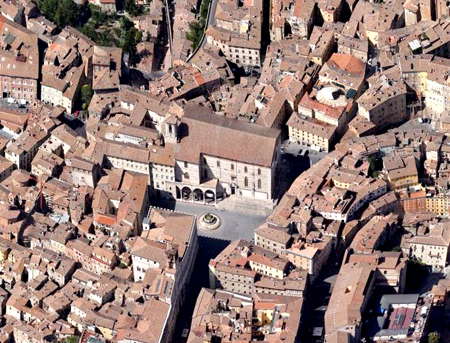
Aerial panorama of Perugia's historic center
THE FLIGHT OVER PERUGIA'S ROOFTOPS
On summer nights, at dusk, accompanied by a faithful servant, he loaded the wings onto a cart and rushed toward Lake Trasimeno. The first time, he launched himself from a height on Isola Maggiore, toward the tip of a windmill "to catch the wind blowing from the north." He used the water as a landing strip to avoid crashing to the ground. And he did well. He glided onto the surface of Lake Trasimeno and was fished out by his assistant. Together, they must have seemed to the Perugians of that era like two eccentric characters captivated by a dream all their own.
Thus, Leone Pascoli described the strange pair in his book "Lives of Perugian Painters, Sculptors and Architects," published in Rome in 1732: "He began to work secretly night and day on iron, springs, and other devices, and having successfully brought everything to completion, nothing remained but to test it. And so that this too would be secret, so that the spectacle would come to Perugia completely unexpected, he awaited the full moon, and in the hours when others sleep most soundly, and in the most remote place of one of those islands so as not to be seen, he adjusted well to his back the devices that formed two wings, and over those waters attempted to fly, and he flew for quite a considerable distance easily; but when, tired, he wanted to stop them, as he would have liked to do gradually, he had to let himself fall onto the waters of the same, where that friend of his awaited him on the shore."
The great opportunity to present his marvelous invention came in February 1498. Perugia was preparing to celebrate the lavish wedding of young Pantasilea Baglioni, descendant of the powerful family of the city's lords, to the famous condottiero Bartolomeo d'Alviano, who the previous year had lost his first wife.
At the height of the festivities, in the Piazza Grande around the Fontana Maggiore, among the dances, songs, and musicians, the attention of the illustrious guests and the people was drawn to the winged man who had climbed onto one of the roofs adjacent to the cathedral. The sounds and cries gave way to silence: Giovan Battista Danti launched himself into the void, wings spread, trusting in the eternal city wind. And he flew for some time over the applauding and astonished crowd. But then the joint of one wing broke and Daedalus swerved, lost altitude, and fell onto a roof near the Sapienza Nuova. He fractured a leg but gained everlasting glory.
Giovan Battista never repeated the experiment. Some time later, he also left Perugia for Venice, where he taught mathematics and worked as a military engineer in service of the Serene Republic until the end of his days. He died at only thirty-nine years of age in 1517.
The echo of his deeds inked the attentive pages of Perugian history by Crispolti, Pascoli, Pellini, and Bonazzi. But it quickly faded, like his dream. What remained was the nickname: Daedalus, still whispered by tenacious cultivators of forgotten stories. And a beautiful Perugian square that today evokes his surname but is not dedicated to him.
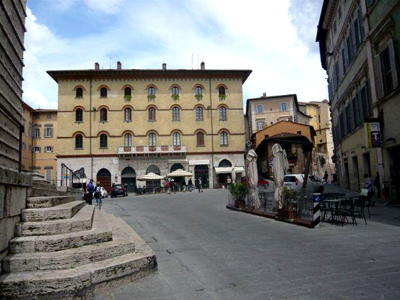
A glimpse of Piazza Danti from the entrance to Piazza IV Novembre
ONE SQUARE, A HUNDRED STORIES
Because Piazza Danti, the stone parlor hidden behind the Cathedral, is named in honor of a great-grandnephew of Giovan Battista: Vincenzo Danti, the only great Perugian sculptor, author of the beautiful bronze statue of Pope Julius III. From the side of the cathedral, his raised right hand seems to bless the daily promenade of Perugians on Corso Vannucci.
Today, few pause to notice the pope's other hand, resting on the chair: the languid yet fierce palm imprisons with a velvety grip the beak and head of a griffin. Thus the artist narrated the destiny of his city, suffocated by the temporal power of the popes. The great bronze once stood proudly behind San Lorenzo.
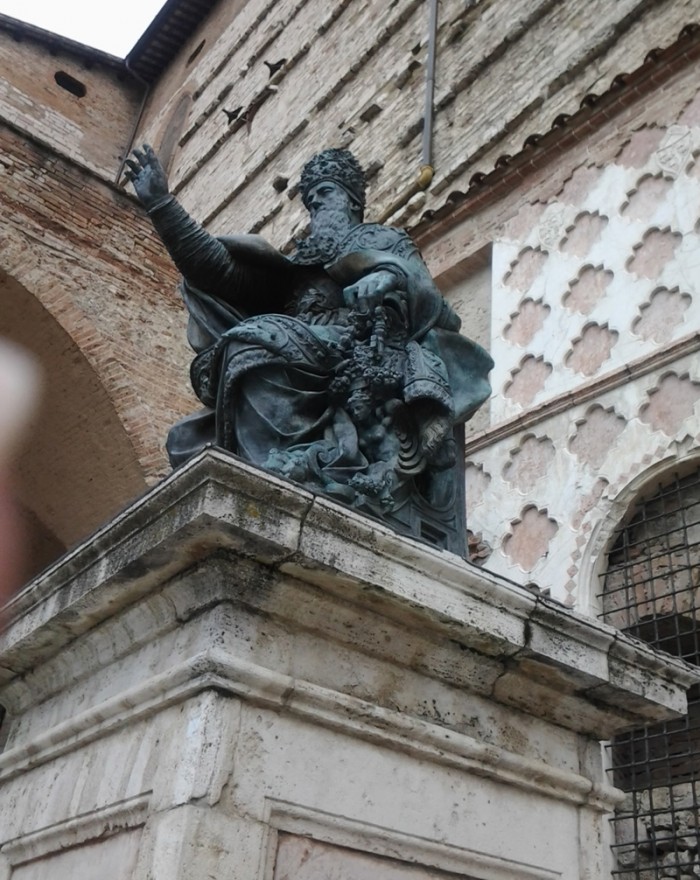
The great bronze statue of Julius III by Vincenzo Danti (1555) seems to bless visitors to Piazza IV Novembre
And the current Piazza Danti, precisely because of the imposing sculpture, was then known to Perugians as the "Pope's Square." The statue was moved in 1899 to make room for the electric tram tracks, which no longer exist. Thus, almost as compensation for the relocation, the urban space was dedicated to Vincenzo Danti. For centuries, that landing place of the vertical city—where the tangle of streets from the ancient gates, alleyways and stairs, after many climbs naturally recomposes before exploring new descents—was also called Piazza delle Erbe and della Paglia (Herbs and Straw Square). A curious trace of the old name remains in the bas-reliefs carved on the buildings, right at the beginning of Via del Sole and Via Bartolo: stone signs almost hidden by recent renovations of the old constructions. They depict hands clutching ears of wheat. Because bread and fodder for horses were sold right there, where now, every week, a terracotta market is hosted.
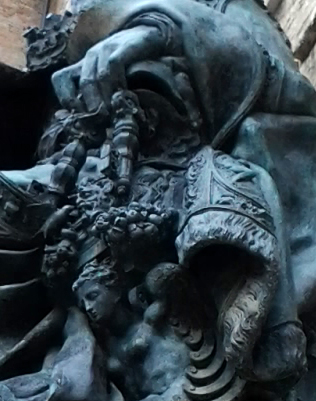
Detail of the Julius III statue: the hand closes the griffin's beak, which almost disappears under the ample folds of the pontiff's sleeve
A few meters to try to understand a city: on the square opens the baroque door of the cathedral dedicated to San Lorenzo, one of Perugia's three patron saints, along with San Costanzo and Sant'Ercolano. All three bishops. All three martyrs and saints. Common yet diverse and personalized devotions. To leave, however, another possibility of choice, even in prayer. And almost facing the temple, the Etruscan Well, dug three centuries before the birth of Christ: a dark vein descending thirty-seven meters from which Perugia's deep roots reemerge.
Piazza Danti, just a step behind the Fontana Maggiore and the Corso dedicated to Perugino, protected by the cathedral yet still open toward other directions, perhaps better than any other place narrates the soul of a city that more than exhibiting conceals, hides and often forgets, with the eternal excuse of distraction—the hallmark of a proud yet elusive character.
George Steiner, who in one of his books sought to explain the identity of the Old Continent, perhaps here, seated at sunset before the Turreno café, would find the ideal mixture of a certain idea of Europe, the thread of an identity to be recomposed.
There's the café, place of meetings, conspiracies, debates and gossip, where flaneurs can also dream or huddle warmly when the north wind returns. Here, facing different streets that fork, one can still walk slowly with one's thoughts. The stroll and the landscape risk blending, like memory upon men and things.
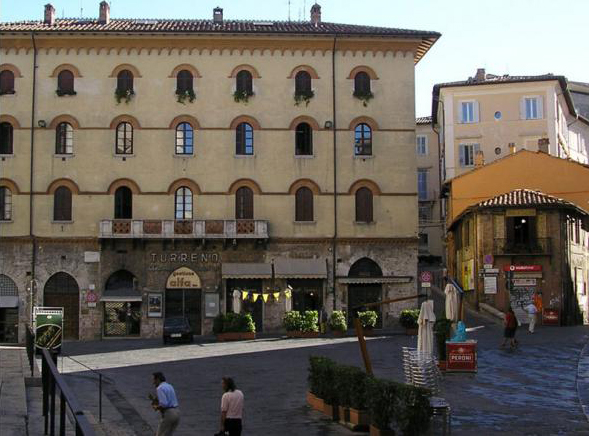
Piazza Danti
THE SOUL OF TOPONYMY
The inscription "Piazza Danti" welcomes the traveler soberly. It's just a word. But it expresses a hidden warmth compared to the cold numbers of anonymous streets and the endless avenues of new and distant worlds. In Europe, even toponymy has a soul. And the name Danti, like the city of Perugia, conceals much more than it shows at first glance.
It still reveals, for those who seek them, the extraordinary events of Giovan Battista's ingenious family: a dynasty that marked an era of genius and beauty in Perugia spanning the fifteenth and sixteenth centuries.
The older brother of the "flying Perugian" was named Pier Vincenzo. He was a true Renaissance man of multifaceted genius: mathematician and goldsmith, he designed and built refined astronomical instruments. He was the son of a notary, Bartolomeo Ranaldi. But he wanted to invent a new identity as well: he loved Dante Alighieri's literature and poetry so much that he requested and obtained permission to change his surname to Danti. His singular request was granted. And from then on, he and his heirs in Perugia were known as the Danti—that is, sons of Dante, the supreme poet who sang of the acropolis in the Comedy: "where Perugia feels cold and heat from Porta Sole..."
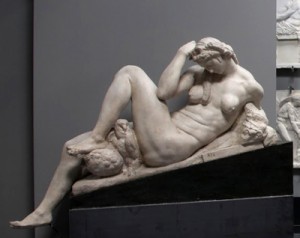
Night, one of Vincenzo Danti's plaster casts donated to the Perugia Academy of Design
FAMILY GENIUSES
Pier Vincenzo had two children. Giulio, architect and goldsmith by family tradition, collaborated with Antonio da Sangallo on the construction of the imposing Rocca Paolina, built in only three years.
His sister, Teodora Danti, was a poet, painter, and passionate devotee of mathematical sciences: she wrote a commentary on Euclid's Elements and was also, in effect, the first Italian art historian, capable of studying and disseminating the sweet painting of Perugino. Like her uncle Giovan Battista, Teodora also had no heirs. So she poured her affection and knowledge onto her brother's three brilliant sons: Vincenzo, Ignazio, and Girolamo.
The firstborn, Vincenzo Danti, author of the statue of Pope Julius III, was an "enfant prodige": he grew up in the myth of Michelangelo, to the point of being called his disciple, even though he never worked with the genius of Caprese. Cosimo I de' Medici, struck by his skill, summoned him to Florence. There the great Perugian sculptor wrote "The First Book of the Treatise on Perfect Proportions" and created authentic masterpieces such as the "Beheading," preserved in the Opera del Duomo Museum, and "Honor Conquering Deceit," which can still be admired at the Bargello. But also the "Madonna with Child" displayed at Santa Croce and the two splendid statues of Equity and Rigor that dwell at the Uffizi. Other marvelous works by Danti include a "Flagellation" that emigrated to the Jacquemart-André Museum in Paris and a "Cupid," long attributed to Michelangelo, which found a home in London's Victoria and Albert Museum. Vincenzo worked away from his city for sixteen years. But when he returned to Perugia, he also found time to found the famous Academy of Design, now the Academy of Fine Arts, to which he donated splendid plaster copies of Michelangelo's four "Times of Day."
-
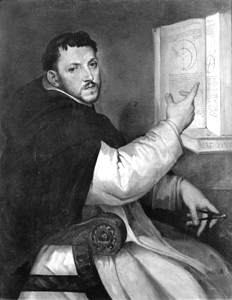
Ignazio Danti, eclectic and brilliant in the sciences, painted the panels of the Gallery of Geographic Maps in the Vatican and designed today's Gregorian Calendar
THE ENCYCLOPEDIC IGNAZIO
A new surname to wear like an immaculate garment. Giulio's second son honored the poet his grandfather wanted as an ancestor. He followed the destiny of the Danti, carved in prophetic verses: "You were not made to live like brutes, but to follow virtue and knowledge."
He decided to become a friar. He too changed identity: he was baptized with the name Carlo Pellegrino in the year 1536. But from the day he crossed the threshold of the convent of San Domenico, when he was just over nineteen years old, he was called Ignazio. He immersed himself in prayer and the study of mathematics, geography, and astronomy. Then he moved to Florence, to the monastery of San Marco, where he taught mathematics and sciences to the daughters of the Florentine aristocracy.
Cosimo I de' Medici, protector of artists and scientists who already had the sculptor Vincenzo Danti in his service, struck by his abilities, summoned him to paint precious geographic maps of the then-known world in the Guardaroba of Palazzo Vecchio. The work, marvelously described by Vasari, amazed contemporaries and thrilled the grand duke.
Ignazio, along with other scientific instruments, also created a terrestrial globe and a splendid astrolabe. A few years later, he built a marble quadrant with eight sundials on the facade of Santa Maria Novella. And he transformed the church into a great astronomical observatory, in which he also installed a gnomon to measure the sun's exact position in the sky. Cosimo I rewarded Ignazio with the establishment of a chair in Mathematics. Danti repaid him with another extraordinary discovery, forty years before Galileo: a rudimentary telescope which he used to follow the movements of the North Star.
Like his uncle, the "flying Perugian" Giovan Battista Danti, Ignazio also set no limits: in long conversations with Cosimo de' Medici, he conceived the grandiose project of a water connection between the Tyrrhenian and Adriatic seas, along the Apennine valleys exploiting the course of the Arno, a futuristic canal, and the forced creation of some artificial lakes.
The death of the grand duke interrupted that visionary dream that scandalized the Medici court and aroused envy among the favorites of the noble house.
Danti then left Florence and moved to Bologna, where he soon became professor of mathematics at the prestigious city university. Between one lesson and another, he also found time to build the beautiful meridian that still adorns San Petronio today and to calculate the exact circumference of the terrestrial globe.
-
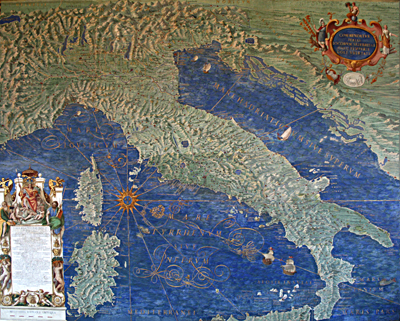
The map of the Italian peninsula, one of the maps drawn by Ignazio Danti for the Vatican gallery
His life changed course when the jurist Ugo Boncompagni, who like Ignazio had taught in Bologna, was elected pope under the name Gregory XIII. Danti could not refuse his colleague, who called him to Rome to paint the maps of Italy in the Gallery of Geographic Maps, now visitable in the Vatican Museums.
The great Perugian cosmographer united the Beautiful Country in the name of beauty, culture, art, and religion. The walls of the spectacular gallery, one hundred twenty meters long and six wide, are covered with twenty geographic maps in different scales, colored and populated with coats of arms, emblems, and symbols in which every country, every valley, every river, and every mountain is recognizable. And on the azure seas, barely rippled, that surround the peninsula, ships of every shape and color float.
In Umbria, Ignazio's homeland, around Lake Trasimeno, horses, encampments, and soldiers swarm: a Latin inscription recalls the great Roman defeat at Hannibal's hands near Tuoro.
Thus, in the aerial pathway along the Vatican Gardens, the austere and learned Gregory XIII, champion of the Counter-Reformation, could stroll through Italy in 1580, which he considered his private garden, without even leaving his palace.
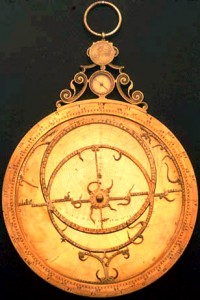
The astrolabe
THE CALENDAR AND THE OBELISK
The wonder that still grips visitors at the sight of the Gallery of Geographic Maps was the same that seized contemporaries. But Ignazio Danti had yet to complete his greatest work, the one for which he passed into history: he was the principal author of the calendar we all still use. The Gregorian reform was not born from scientific motivations, but religious ones: the solar calendar had to coincide with the ecclesiastical calendar. Since the time of the Council of Nicaea in 325 BC, the calendar had fallen behind the Sun by ten days. And Easter was moving increasingly toward summer. It was calculated based on the date of the spring equinox, which had been decided at that historic religious assembly.
In the Tower of the Winds of the Vatican, on the attic floor, the meridian line is still traced thanks to which Ignazio explained the error to the pope: in the second half of the sixteenth century, the phase shift was now evident. Gregory XIII, convinced by Danti, took action and to solve the problem appointed a special commission of which the Perugian bishop was also a member.
And on the evening of October 4, 1582, Italians, French, Spanish, Portuguese, and all other Catholics in the world shortened their lives: when they woke up, it was October 15, 1582. They had not slept ten days: from that fateful morning, the Gregorian calendar that replaced the Julian calendar came into force. Protestant countries had to wait until the eighteenth century to conform to the novelty. And Sweden, which did so gradually, became mired in a muddle of dates: the year 1712 in Stockholm and environs was a doubly leap year with a February of thirty days.
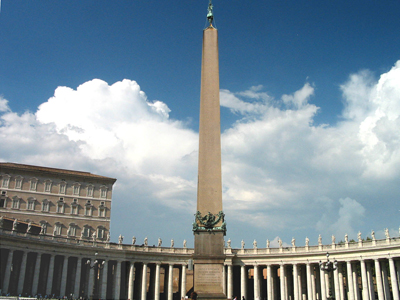
The obelisk of St. Peter's Square in Rome
Ignazio lived through those days of glory without talking about it too much, as was his custom. The pope, grateful, rewarded him with the position of bishop of Alatri. From then on, the encyclopedic Dominican applied himself diligently to the care of souls. But he did not neglect his studies. In 1583, perhaps thinking of the years of his childhood and the teachings of his aunt Teodora, he wrote a brief history of perspective. He also built other devices that served to perform complex mathematical calculations along with anemoscopes capable of accurately indicating wind direction. In the archaeological museum of Perugia, parts of these precious instruments are still visible.
Gregory XIII died. Sixtus V was elected in his place. The new pope also turned to Ignazio Danti for the difficult operation of moving the obelisk to St. Peter's Square. The Egyptian monument, an enormous monolith in red granite, three thousand years old and twenty-five meters high, was brought to Rome on Emperor Caligula's orders in 40 AD. To prevent it from breaking, the Romans loaded it onto a ship filled with lentils. Positioning the stone giant at the center of Christianity's most important site was an equally complicated operation. Ignazio guided the work masterfully. Even today, the obelisk serves as the square's meridian, and at its base one can see the drawings of the equinoxes and solstices traced by the great astronomer.
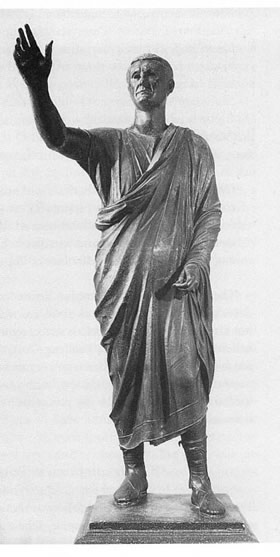
The Orator
THE "MYSTERY" OF THE ORATOR
That drawing of the heavens was Ignazio's last work; he died at fifty. He survived all his family members. Including Girolamo, who was eleven years his junior and who, following family tradition, was a goldsmith and painter.
The youngest of the Danti remained almost always in Perugia, in the Renaissance workshop of his elderly father Giulio. He painted the sacristy of the Basilica of San Pietro and frescoed a wall of the cloister of San Domenico. He collaborated with the famous Ignazio on the realization of the marvelous geographic maps in the Vatican. Many of his works were lost. Those remaining can still be admired in the cathedral museum of Perugia, inside the church of San Domenico in Gubbio, within the Abbey of the Seven Friars near Pietrafitta, and in the collegiate church of Umbertide.
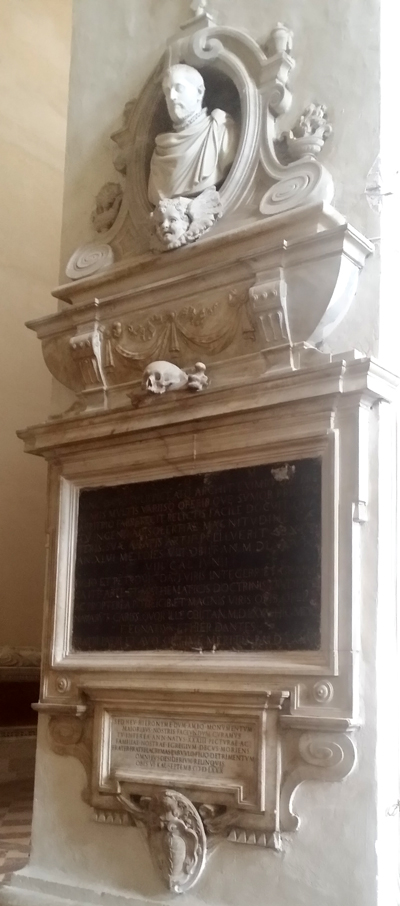
The Danti tomb in the church of San Domenico
All of Giulio's sons, together with the patriarch Pier Vincenzo, now rest in Perugia's Basilica of San Domenico, the largest church in Umbria. There Ignazio was born, there he was ordained a friar, and there he wished to be buried. Together with Girolamo, he designed his tomb and that of his relatives: the sepulcher stands out on a column of the temple, to the left of the presbytery, surmounted by a small bust depicting Vincenzo, the sculptor. A Latin epigraph carved in stone recalls the greatness of the inimitable family.
Almost silently passed another affair: an archaeological "mystery" in which nearly all members of the dynasty were involved—the illegal transport from Perugia to Florence, in 1566, of the precious statue of the Orator, a life-size Etruscan bronze found by a sharecropper in a vineyard near Pila.
The farmer sold it to Giulio Danti. But it immediately disappeared from the goldsmith's workshop in Perugia's center and went to enrich Cosimo de' Medici's extraordinary collection of masterpieces. The statue's raised arm was broken to facilitate transport. The Orator, placed in a crate, passed through the Sanguineto customs by night, near Tuoro on Lake Trasimeno, where the border between the Papal State and the Grand Duchy of Tuscany was marked.
The owner of the land where the beautiful bronze was unearthed reported the Danti and the sharecropper. The farmer was imprisoned along with Giulio. The goldsmith was then released, to the great scandal of the city, for one hundred scudi bail. But that's another story.