Umbria: Journey to Italy's Green Heart

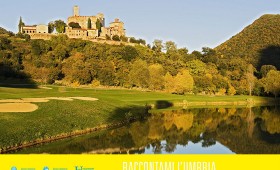
Lake Piediluco in Terni (Photo: Pietro Canali)
This region within the boot-shaped country possesses a little of everything positive from its neighboring territories: rolling hills and artistic heritage, magnificent religious monuments, and exceptional gastronomy.
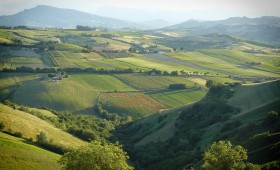
Nestled where the Apennines soften their rugged character and transform into gentle, undulating hills, Umbria stands as one of Italy's few landlocked regions. This absence of coastline has earned it recognition for its natural heritage, proudly proclaiming itself "Italy's green heart." The landscape weaves together patchworks of fields covered with olive groves, pines, and cypress trees, contrasting with the fierce yellow of sunflowers and church towers reaching skyward. It is, ultimately, an Italy far removed from mass tourism, best savored at an unhurried pace.
Whenever I visit Umbria, I establish Perugia as my operational base—not only because it occupies the region's geographical center and benefits from the radial pattern of its roads, but also because it's a captivating city. Its beauty lies in its imperfection, exemplified by Piazza IV Novembre, where Giovanni Pisano's fountain appears almost casually placed. The sloping ground barely conceals the steep terrain, while the Gothic cathedral forms irregular angles with Palazzo dei Priori, the former seat of civic authority.

Perugia, Via dell'Acquedotto
Perugia, like many medieval cities, demands exploration from multiple perspectives to be truly appreciated, as its designers never conceived urban development plans. Inside the palazzo stands the Collegio del Cambio, equivalent to a modern bank. Its walls showcase one of Pietro Vannucci "il Perugino's" finest fresco cycles—the master who taught Raphael. He depicted rosy-cheeked figures who clearly appreciated fine dining. Many appear identical, which is accurate, as 15th-century artists used cartoons to reproduce figures that disciples would then paint; the better an assistant mimicked the master, the greater their esteem.
Enviable Gastronomy
Excellent cuisine pervades Perugia and all of Umbria, where dishes enriched with white or black truffle abound. Many recipes reflect the Umbrians' anticlerical temperament. Here they consume pane sciocco (unsalted bread), created to avoid the papal salt tax. They also enjoy strozzapreti pasta—a name requiring no explanation. This animosity has historical roots: in the 14th century, Cardinal Egidio Albornoz, of Spanish origin and buried in Toledo, laid the foundations in Umbria for unifying the Papal States on behalf of the Avignon pope. To accomplish this, he constructed a series of fortifications that served more to control than defend the territory.
Within this same political context, one of Perugia's most fascinating structures was built in 1540: the Rocca Paolina, a fortress commissioned by Pope Paul III, for whose construction shops and residences were cleared. Destroyed in the mid-19th century, the interior of the Rocca today resembles a catacomb connecting the upper and lower parts of the city. This space now hosts international cultural events that, along with the Umbria Jazz festival and the University for Foreigners, animate Perugia's steep streets.

Gubbio (Photo: Maurizio Rellini)
Gubbio, approximately forty minutes away by car, presents even steeper slopes. This town's first impression comes from its Palazzo dei Consoli (Gothic, 14th century), which dominates the valley from atop formidable arches, as if a giant held it above his head with outstretched hands. The surprise continues upon discovering that the access staircase emerges from a second-floor wall, descending its steps onto Piazza Grande.
The palace museum displays the Eugubine Tablets, seven bronze plaques written in Umbrian and Latin and dedicated to Jupiter. Dating between the 3rd and 1st centuries BC, these tablets demonstrate that Gubbio is the region's most ancient settlement.
Sunlight draws dazzling reflections from the marble covering the Basilica of Saint Francis in Assisi, erected on the slopes of Mount Subasio. On foggy days, observed from near the town, it appears to float in the air. Its interior is rich with frescoes distinguished by their colors and quality of workmanship, not by gold usage, so common in other churches.

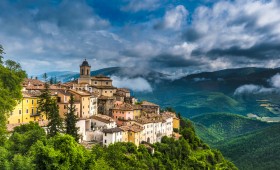
Assisi (Photo: Francesco Iacobelli)
Assisi lies approximately 50 kilometers from Gubbio and only 25 from Perugia. Saint Francis was born here to a merchant family; he renounced all possessions when he felt the call of faith while praying where the Basilica of Santa Chiara now stands, across the city. I've always found curious the story of Saint Clare being proclaimed patron saint of television: gravely ill, she couldn't attend Christmas mass, but divine intervention allowed her to witness the celebration in spirit. In 2008, proposals emerged for her to become internet's patron saint as well, though this idea gained no traction.
Ascending toward the basilica, various shops sell nativity scene figurines—Saint Francis's invention. Inside the Upper Basilica, the fresco "Nativity at Greccio" depicts the moment this occurred. It's merely one of 28 scenes painted by Giotto, though I prefer Cimabue's work in the crossing, executed with a technique reminiscent of photographic film negatives.

The Expulsion of Devils from Arezzo (Giotto, Upper Basilica of Saint Francis, Assisi)
Reconstructing History
Everything visible today was painstakingly reconstructed by Sergio Fusetti's team. I once had the opportunity to interview him and observe how he reassembled the gigantic 300,000-fragment puzzle into which the dome and central nave had been reduced during the 1997 earthquake. The church survived World War II bombing because Germans had established a hospital within it.
The route continues southward to Spoleto, passing through Spello, Montefalco, or Foligno—three delightful medieval villages forming a perfect combination of viewpoints for contemplating the panorama. We then enter the Valnerina, the Nera River valley, extending toward the Sibillini Mountains and the National Park bearing their name. This privileged zone attracts hiking enthusiasts, with trails winding among villages unchanged by time, untouched by central Umbria's medieval power.
Noteworthy is the municipality of Sant'Anatolia di Narco, where exceptional food can be found even in the humblest establishment, and the Marmore Waterfall, so named for the calcium carbonate that tints its waters white. Located within the Nera River Park, 8 kilometers from Terni, it owes its origin to a canal constructed during the Roman Empire. Facing such beauty, it seems absurd that Roberto Benigni chose the Valnerina as the concentration camp setting in his film "Life is Beautiful" (1997).

The vineyards of Montefalco
The reference point in this zone is undoubtedly Spoleto. Cardinal Albornoz's fortress rises at its summit, though the first element commanding attention when approaching is the aqueduct connecting the municipality with Monteluco. The varying widths of its rounded arches reveal completion across different eras. Once in the historic center, the 12th-century cathedral surprises visitors with an unexpected Baroque interior and excellent frescoes by Filippo Lippi. A painter of the Italian Quattrocento, Lippi detested the idea of dying there, which is why he depicted himself making horns in the fresco portraying the Death of the Virgin (Dormitio Virginis).
Less irreverent is the decoration of Orvieto's cathedral, the next artistic stop on our circular route around Perugia. Uncompromisingly Gothic, a chapel contains Luca Signorelli's "The Damned Cast into Hell," a work that seemingly inspired Michelangelo for his version of the biblical passage in the Vatican's Sistine Chapel. Moreover, though the city approaches dangerously close to a promontory, the most curious element isn't visible but resides underground, where a series of cavities were already utilized by Etruscans and, until today, have been employed to preserve foods at low temperatures.
Near Lake Trasimeno, other cavities are still used to age wines, for example, in cellars near the town of Castiglione del Lago. Generally, local wines are produced with Sangiovese grapes, but also with Sagrantino, a variety imported from Asia Minor by Saint Francis's followers. With a glass in hand, as the sun sets over the shores of one of Italy's most extensive lakes, I'd say they had an excellent idea.
Josep M. Palau
This article, published in National Geographic España on July 9, 2017, won Josep M. Palau the 2018 edition (Tourism, Environment and Culture section) of the International Journalism Competition "Tell Me About Umbria," established by the Perugia Chamber of Commerce with participation from the Terni Chamber of Commerce.
Articles from "Tell Me About Umbria" can be consulted at: www.obiettivoimpresaweb.it
Original article: Umbría, viaje al corazón verde de italia