A Sea to Navigate by Sight

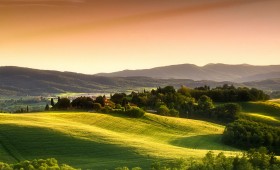
My passion for seas and islands has led me to deeply appreciate Umbria. This is how I describe this landscape—a sea, indeed, spreading out before the porch of the home where I live. That's what I told myself while flying over the region by helicopter for a film project. And that's how anyone can perceive it when reaching the summit of a shaded hill via a secondary road, or climbing the tower of one of its castles. From up there, you'll witness a green sea stretching gently before you, with subtle variations in hue, gradually blending into the horizon where it meets the sky.

Its islands emerge—rising contours of the terrain (calling them mountains would be excessive)—and together they form a vast archipelago. Like any archipelago, they present themselves as remarkably similar to one another yet each possesses its own distinct characteristic, an identity that remains unmistakable even when subtle.
"My" island faces others so nearby that I can hear the bell of one of their churches when it rings—an echo different from the one reaching me from the village on the opposite hilltop.

The nuances differ, too. For instance, when I head to the little square of that village rather than another to buy bread or a newspaper, the typical characteristics of an archipelago immediately reveal themselves—identity within diversity. The small square where I dock isn't fundamentally different from the one I visit daily (same simple architecture, same warm tones of terracotta and brick), yet here the space forms a perfect square, while there it's oval-shaped. Here, the balcony overlooking the valley below is shaded by a row of centuries-old cypresses; there, instead, a portico covered with roof tiles provides shelter. And it's possible that the olive oil produced in this village presents a certain difference from that made in "mine"—perhaps because the experience of whoever operates the mill differs: this one presses "hot," that one, instead, works "cold."
Certainly, there are also far more significant and important differences between one Umbrian island and another. Here, a fresco by Perugino offers itself to admirers as a monarch of Italian painting. There, they carry in procession a silver, gold, and translucent enamel reliquary—a unique work in form and color. And there, in that square, the bands of Umbria Jazz perform; in that other one, a renowned conductor leads a famous classical orchestra.
Anyone preparing to navigate the sea of Umbria and its islands will find comprehensive notes and routes to discover these infinite, diverse, grand, and unexpected cultural, culinary, and atmospheric offerings by consulting a good guidebook (pardon me, I meant to say portolan chart).
I'll add just one piece of advice: prefer above all navigation by sight. You need the courage to leave the paved route and take on an unpaved one, even if at times it may seem nearly impassable and you must endure potholes and stones. But you won't regret it, because you'll eventually arrive at that cluster of houses buried among the olive trees, and from up there you might suddenly notice that, with a gust of wind, the green sea spread out in the valley below has turned silver—just as happens to those sailing the open sea who encounter a blast of mistral wind and watch the crests of waves whiten with foam.
Or from that high vantage point over the landscape, you might see rising from the skyline of the hills the octagonal form of a tower, or the openwork summit of a cathedral.
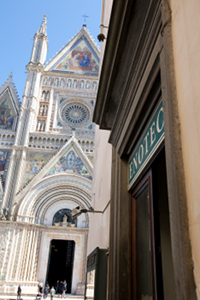
In this case, it could be Orvieto's cathedral, beneath which my wife Anna and I often pause in admiration.
One day we found ourselves observing it alongside a friend, the refined art critic Cesare Brandi. He gazed long at the Cathedral, gilded in the day's last light, said nothing, but then for the film I was making, he wrote me some moving lines: "It's the most beautiful in Italy, that facade. Immense, delicate as a carved miniature, like a page you cannot turn, you gaze at it endlessly and something melts inside you, silently like communion."
Folco Quilici